


Obsolescence or Competitiveness in Flexographic Printing?
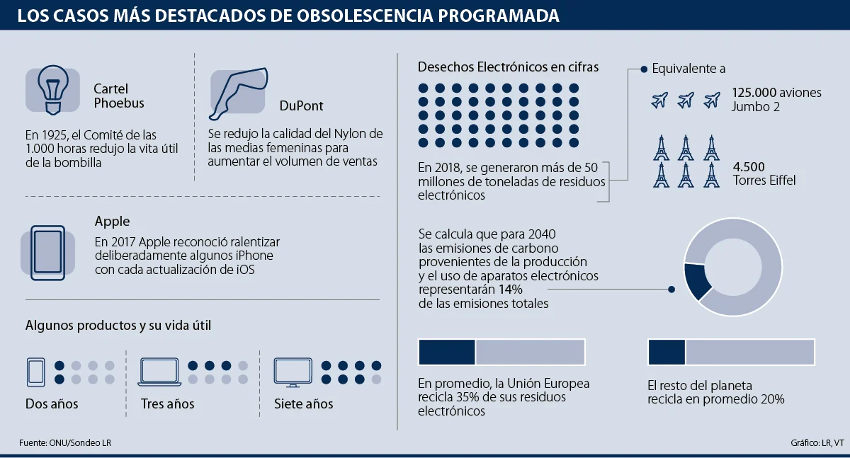
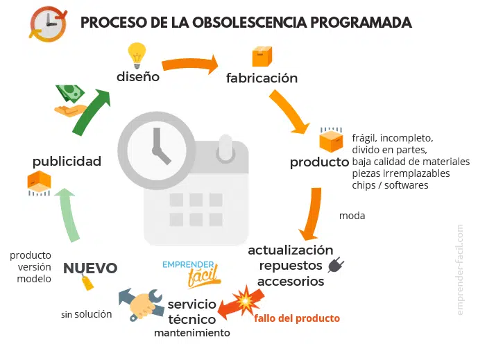
The term "planned obsolescence" is becoming increasingly familiar. Do you think it has also reached the flexographic printing industry? Our company provides consulting services worldwide. With the experience of our consultants and the various problems we encounter and that our clients bring to our attention, we have often asked ourselves the question of planned obsolescence.
Causes of Obsolescence
Among the causes that lead to product obsolescence, the following stand out:
- Innovation.
- Research and Development.
- Expiration Date.
- Expiration of Useful Life.
- Incompatibility with new products.
- Discontinuing.
- Lack of Spare Parts.
You've probably experienced this: you have a problem with an inspection camera, you call the printer manufacturer, and they direct you to the camera manufacturer, since they no longer provide spare parts or support. But it turns out that the same manufacturer gives the same answer: that model is no longer serviced because it was manufactured for brand X. Keep in mind that in Europe there's a law that requires spare parts and service for 10 years.
https://eur-lex.europa.eu/legal-content/ES/TXT/PDF/?uri=OJ:JOC_2018_334_R_0007&from=ES
There are printers with a dot gain that's 10% lower. Or, to put it another way, there are very economical and attractively designed printers that have a dot gain of 10% to 15% compared to the aforementioned printers or others of varying cost.
Obviously, if you don't have these machines side-by-side, you can't compare them, but cliché manufacturers can certainly provide this information.
You've probably also noticed that anilox rollers wear out faster and develop scoring lines more easily. You likely still have anilox rollers from 10 or 15 years ago with almost no wear, even without scratches, while one with the same volume and line screen characteristics lasts at most 3 years.
Currently, they are softer and even of lower quality, with porosity as low as 3%, leading most manufacturers to claim they have a special treatment for better transfer... you be the judge. Adhesive tapes are expensive, but their characteristics are also being modified for better and faster printing, but this comes at the cost of lower quality and a slightly lower price to be more competitive in the market.
We could continue giving examples of this with inks, clichés, doctor blades, cliché holders, adapters, and even printing presses.
All customers want to be more efficient in their plants, and it's possible. However, if products are purchased based solely on price, the cheapest and least durable options are chosen, increasing our annual costs. This forces manufacturers to develop even cheaper products that attempt to match the performance of their predecessors. We know this won't be possible, but price wins out. Many of these manufacturers also raise the price of their high-quality products, those without obsolescence, to force the market to choose the cheapest option.
On the other hand, if we purchase top-of-the-line products, even if they are very expensive, we will likely:
- Achieve faster results, as the machine will be more robust and stable, offering additional features and a longer lifespan, delivering the same results for 20 years.
- Print more meters with the same adhesive fabric on the printing plates, eliminating porosity and the need to apply pressure to the plates, thus reducing their lifespan.
- Use high-quality blades for the Doctor Blade, eliminating the possibility of scoring lines.
- Anilox rollers that can print for 15 years with only a 3% loss, although this is obviously not in the anilox manufacturer's interest, we understand.
- Equipment where the software or hardware provides at least 10 years of assistance or support, such as vision cameras for printing and other equipment.
You're probably asking yourselves these questions. What do you think? Feel free to write to us and we'll discuss it.